

Faculty of Engineering
Project
for B.Sc. Degree in Mechanical Engineering
Final report
|
Project (No. 222): |
|
|
Establishing correlations between various parameters characterizing the output of a piezoelectric actuator. |
|
|
Performed by: |
Idan Avihar (I.D. 037682440) |
||
|
Instructor: |
Dr. Avi Seifert, |
||
|
Location: |
|
Idan Avihar

|
Idan Avihar |
|
|
Project overview
Since the 1990s developments in adjacent fields like Micro Electro-Mechanical Systems (MEMS) and materials like piezo-ceramics have led to the emergence of innovative actuator strategies, such as Zero-Mass-Flux-Jets (ZMFJ). ZMFJ, also known as synthetic jets, have the property that they require no net mass flux, unlike conventional continuous control jets or pulsed jets. The jet is created from the ambient fluid in which it is embedded. Although there is no mass injection into the overall system, momentum is transferred into the flow.
The purpose of this project was to study the basic governing parameters of a Zero-Mass-Flux-Jet piezoelectric (PZT) actuator to provide a preliminary database for establishing the relation between them. Preferably, the relations between these parameters would in future work be presented in the form of transfer functions. Calculating the magnitude and the phase of each of the measured parameters from the acquired signals at all relevant frequencies, will enable to obtain a transfer function between the AC voltage applied to the PZT disk and the velocity of the jet.
The initial step was to design an experimental system, which will enable to measure simultaneously the following parameters:
· Frequency and amplitude of the input AC signal to the piezoelectric membrane.
· The deflection of the membrane using Fiber Optic Displacement Sensor (FODS).
· Pressure fluctuations in the cavity using sensitive electronic pressure transducer.
· The velocity of the synthetic jet exhaust from the orifice using hot wire transducer.
· Ambient Temperature and the Temperature inside the actuator’s cavity.
The basic concept in the design of the experimental system was to enable maximum flexibility in its maintenance and with the use of measuring instruments. Another important guideline was to assure a high level of test automation, in order to enable the simultaneous data acquisition as required, as well as consistency and repeatability.
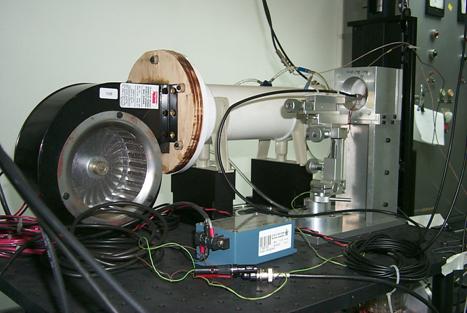
The main components of the experimental system consisted the followings:
· An actuator box of (the size of 8mm X 8mm X 6.5 mm) with a removable plastic cove, with a circular orifice (diameter of 3mm) in its center.
· A brass diaphragm (diameter of 50mm) on which a piezoelectric disk (diameter of 25mm) was adhered. The diaphragm was attached to a cylindrical threaded conductor, in a way that enabled to change the depth of the cavity between the diaphragm and the plastic cover.
· An optical displacement sensor, to enable measuring the displacement of the oscillating diaphragm.
· A pressure transducer, which was installed on the circumference of the cavity. Aimed to measure pressure perturbations in the cavity generated by the oscillating diaphragm.
· Hot-wire anemometry system to measure the velocity of the oscillatory jet exiting from the orifice.
Data acquisition was performed after the calibration of the displacement sensor and the resonance frequency and shape mode of deflection of the diaphragm. Two types of measurements were taken – frequency scans and amplitude scans. In frequency scans the above-mentioned parameters were measured while the frequency of the excitation signal was the only parameter varied. Amplitude scans were basically similar to frequency scans, only that in this case the independent variable was the voltage applied on the PZT disk. Data was acquired for several cavity depths and at several excitation amplitudes.
Processing the acquired data revealed the dependency of the jet velocity on the pressure perturbations in the cavity, and of the latter’s on the displacement of the diaphragm. The displacement is governed by the excitation signal. Pressure perturbations, unlike the displacement of the diaphragm, are strongly dependent upon the depth of the cavity. The velocity seems to be linearly dependent upon pressure perturbations, a dependency which is weakly affected by the depth of the cavity.
The major finding of this project is related to the acoustic resonance of the cavity. Apparently, the performance of the actuator operating at the acoustic resonance frequency, are more efficient than operating at the resonance frequency of the diaphragm. Conclusively, it is assumed that if the resonant frequency of the actuator would equal to the acoustic resonance frequency, the oscillating jet velocity would increase significantly. This assumption had not yet been proven. Nevertheless, the database created in this project should be the basis for future work, which will eventually lead towards an improved modeling and design of piezoelectric driven actuators.
The conclusions from this work also include two rather limited approximations, which in certain conditions could be used to estimate the properties of a Zero-Mass-Flux piezoelectric driven actuator. The first approximation enables to estimate the acoustic resonance frequency of the cavity. The second provides a tool for predicting the output peak velocity of the oscillatory jet when operating at the resonance frequency of the diaphragm. Both approximations are accurate enough only for small cavities.