
הפקולטה להנדסה -
המגמה להנדסה מכנית
מאי 2002
Design and Construction of a
Solar Radiation Measuring Instrument.
The
Brief Management Summary
The Final Project
מנחה: דר. אברהם דיין
Brief management summary.
Project description.
The aim of this project is to design,
to construct and to calibrate the instrument for solar radiation measuring.
Project assignment.
Measuring of the solar irradiance plays
an important role in meteorology, agriculture, thermal design of buildings and
especially in the field of the solar energy utilization.
Today's market offers very broad
spectrum of such instruments, based on different principles and constructed by
various manufacturers. However, the conducted survey shows, that the prices
vary from 400 USD for the simplest device up to 1.500 USD for the most
sophisticated (EPLAB pyrheliometer, which is taken as reference). Since these
prices can be significantly reduced, this project is concerned with the
building of an instrument for solar radiation measuring, with an adequate
precision and response time, but within low budget.
The constructed instrument will be used
by the Heat Transfer Laboratory in
The
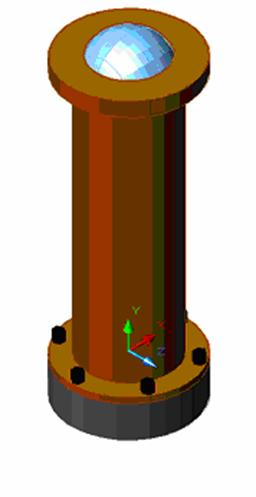
final design of the pyrheliometer consists of a small circular collecting
surface, covered with a Nextel black coating (high emittance flat paint).
The collecting surface is maintained suspended by the K-type thermo-couple,
which is penetrated through the teflon holder. The collecting surface is
located inside the cylinder tube, which can be air-evacuated, in order to
prevent heat transfer from the surface, by any phenomenon, except
radiation.
The
final design description.
|
The
final design of the pyrheliometer consists of a small circular collecting
surface, covered with a Nextel black coating (high emittance flat paint).
The collecting surface is maintained suspended by the K-type thermo-couple,
which is penetrated through the teflon holder. The collecting surface is
located inside the cylinder tube, which can be air-evacuated, in order to
prevent heat transfer from the surface, by any phenomenon, except
radiation. |
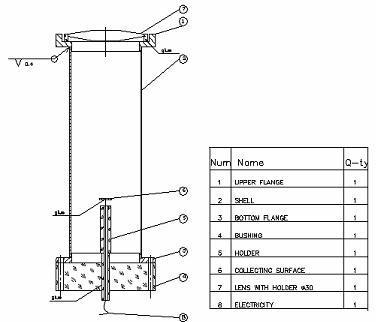
The thermo-couple is glued to the
collecting surface in order to measure its temperature. The thermo-couple can
be connected to the same temperature transmitter as the heat pipe solar
collector. In this option the transmitter will convert automatically the
measured temperature into the solar irradiation according to derived formula.
The additional option is to connect the pyrheliometer thermo-couple to the
mobile thermometer transmitter. In this case the obtained temperature must be
converted to the radiation flux by the means of the calibration chart or by
substitution to the characteristic formula. The cylinder is prepared from the
thin copper plate, covered with Nextel black coating from inside and polished
from the outside. This is done in order to make the surface diffusive, to
absorb all the radiation emitted by the collecting surface from the inside and
to emit all the absorbed heat by convection from the outside. On the top and
the bottom of the cylinder, two flanges are tin-soldered. On the upper flange
the glass lens is installed in such a way that its distance from the collecting
surface is equal to the lens focal length – focusing the incident radiation at
the center of a surface. From the bottom, the cylinder is closed by the teflon
bushing. Likewise, as an option, the side-lock through which the air is
evacuated, can be connected to the bushing. The pyrheliometer is mounted on two
degrees of freedom holder, in order to enable free movement of the instrument,
while directing it to the sun according to the azimuth and the altitude. The
instrument precise direction to the sun is ensured by the means of adjustment
of the upper flange shadow exactly as to cover the bottom one. After being
directed, the pyrheliometer is screwed firmly by the means of two bolts.
Results
Pyrheliometer specifications.
|
Description |
Initial Requirement |
Specified |
|
|
Sensitivity [W/m2 oC]: |
N.A |
8.6112 |
|
|
Temperature dependence: |
N.A |
Independent |
|
|
Linearity: |
Linear |
Linear |
|
|
Response time [sec]: |
180 |
130 |
|
|
Error: |
< 5% |
<
5.1% |
|
|
Dimensions: |
Length [cm]: |
N.A |
11 |
|
|
Diameter [cm]: |
N.A |
4 |
|
Weight [gr]: |
N.A |
270 |
|
|
Total Price [USD] |
150 |
133 |
|
- The response time
τ, obtained at the experiments and theoretically is 130 sec, which is
less than the initial requirement, introduced at the job proposal and the
intermediate report. Likewise, this time is less than the sun-loss time (5
min). Which is very important, otherwise, the temperature would not have
been stabilized before the concentration dot have leaved the receiver.
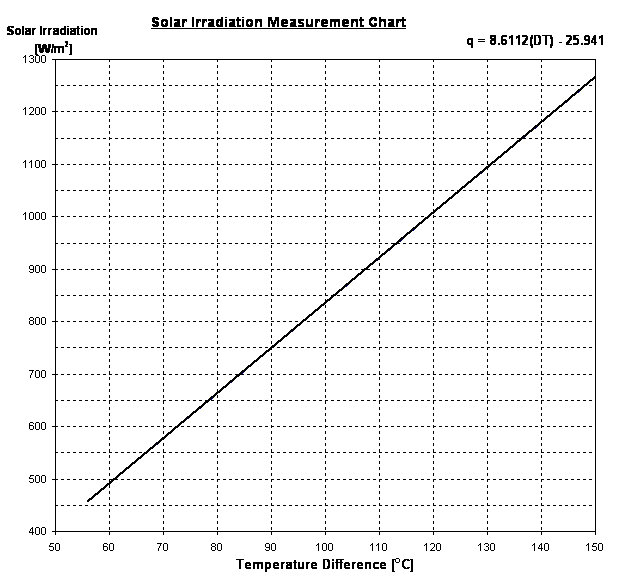
- Linear behavior
in all the range. This feature is very important for two reasons:
a.
The instrument
possesses the stabile behavior,
b.
The obtained
temperature can easily be converted to the solar radiation flux with the aid of
the characteristic formula or by Pyrheliometer Chart (Chart F in the Appendix).
- Total Price: 133
USD. It is less than 150 USD as was required initially at the job
proposal. Likewise, the above price comprises less than 10% of the EPLAB
pyrheliometer cost).
- The total error
is not bigger than 5.1%. Although it is slightly bigger than the 5% error
at the initial requirement, it can be reduced easily as will be shown in
the discussion paragraph.
- Applicability.
The pyrheliometer has already been used successfully at the frame of the
project, conducted by the Heat transfer laboratory in cooperation with
European Union Market. Pyrheliometer measurements were used for evaluation
of efficiency of the solar heat-pipe type collector prototype.
- Compactness and
mobility. Due to its small dimensions, the constructed pyrheliometer is
much more compact and light, comparing to EPLAB pyrheliometer. Likewise, the
pyrheliometer may be connected to the mobile thermometer. Thus, its
geometry and transportability options make the pyrheliometer more mobile
and allow measurements at the fields, where electricity may be
unavailable.
- The theoretically
based formula, which transforms directly measured temperature into solar
irradiation, was developed and it is in good agreement with experimentally
obtained data and the calibration chart.
- According to the
experiments data, the usage of vacuumation pump had not improved significantly
the measurement results. Consequently, it was decided to use the
pyrheliometer without application of the pump. Which of course donate to
the mobility and simplicity of the pyrheliometer.
Discussion.
Although
the realization of the project was successful, there are several aspects, which
may be improved.
- The cost of the
pyrheliometer can be significantly reduced. Most of its price is the
manufacturing the tube from the flat paint coated plate. This was done,
since the coating was performed, before the final design of the model was
configured. Consequently, it was decided to coat the raw material and to
convert it afterwards into the desired shape. If the coating is applied inside a ready
tube, the cost will be reduced.
- The heat loss
through the thermo-couple can be reduced by usage of the thermocouple with
thinner wires. Which will diminish the area of the conduction heat
transfer and thus reduce the losses. Likewise, the thermo-couple with less
error will diminish the relative error of the pyrheliometer. The T-Type
thermo-couple l answers the both demands. With the error of 0.5% the
relative error in the temperature measurement will be reduced to 0.6% and
consequently the total error will not exceed 3%.
- In the performed
calculations and assumptions, the optical efficiency was deduced according
to the properties of the involved geometry. However, they have not to be
real. The calculations of the optical efficiency could be improved if the
properties of the lens were properly defined by the manufacturer or by
spectrophotographic test.
- The additional
experiments over the whole possible spectrum of solar fluxes must be
conducted, in order to confirm the assumption of the linearity over the
all range. Likewise, these experiments will reduce the error of the
Pyrheliometer Chart.
The constructive parts of the pyrheliometer were
those found on stock of the workshop and were not exclusively manufactured for
this construction, since it was not part of the workshop schedule. Therefore,
the work was completed at the free time of the workers. For this reason, the
aesthetic appearance of the two degrees holder can be improved.