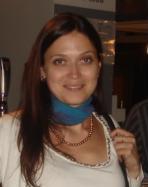
Helena Vitoshkin
School of Mechanical Engineering,
Tel-Aviv University | email: vitosh@eng.tau.ac.il

Resume
I received my Ph.D degree from Tel-Aviv University in 2013. Currently, I am a researcher at the School of Mechanical Engineering in collaboration with Prof. Alexander Gelfgat and Prof. Eyal Heifetz and working as lecturer at Department of Biomedical Engineering.
My research experience lie in the fields of computational fluid dynamics, hydrodynamic stability analysis, parallel computing (MPI).
A detailes can be found in my CV >>
Publications
Articles
H. Vitoshkin, E. Heifetz, A. Yu. Gelfgat, N. Harnik: On the role of vortex stretching in energy optimal growth of three dimensional perturbations on plane parallel shear flows. J. Fluid Mechanics, vol. 707, pp. 369-380, 2012.
H. Vitoshkin, A. Yu. Gelfgat: Non-modal disturbances growth in a viscous mixing layer flow. Under revision in Communications in Computational Physics.
H. Vitoshkin, A. Yu. Gelfgat: On direct inverse of Stokes, Helmholtz and Laplacian operators in view of time-stepper-based Newton and Arnoldi solvers in incompressible CFD. Commun. Comput. Phys., 14 (2013), pp. 1103-1119.
Theses
Computational modeling of two- and three-dimensional non-modal disturbances growth in homogeneous and stratified viscous mixing layer flows. Ph.D theses, Tel-Aviv University,. April 25 2013.
A computational study of modal and non-modal instability in parallel shear flows. M.Sc. theses, Tel-Aviv University, 2007
Computer assisted device selection and adjustment of hearing aid. M.Sc. theses, Faculty of Electro-Acoustic Engineering, Kiev Poltytechnic University, Kiev, Ukraine, 1997
Conference abstracts
2008 Vitoshkin H., Gelfgat A.Yu. Non-modal instability of mixing layer flow. 7th European Fluid Mechanics Conference, presenting author. Manchester, UK.
2009 Vitoshkin H., Gelfgat A.Yu. Energy and enstrophy norm growth in the viscous mixing layer flow. 4th International Symposium "Bifurcation and Instabilities in Fluid Dynamics", presenting author. Nottingham, UK.
2010 Vitoshkin H., Gelfgat A.Yu. Transient growth in a viscous shear flow. 8th European Fluid Mechanics Conference, presenting author. Bad Reihenhall, Germany.
2010 Vitoshkin H., Gelfgat A.Yu. On non-modal disturbances growth in a viscous mixing layer flow. 31st Israeli Conference on Mechanical Engineering, presenting author. Tel-Aviv, Israel.
2011 Vitoshkin H., Heifetz E., Gelfgat A.Yu. On the generic role of vorticity stretching in three-dimensional transient growth of plane parallel shear flows. 5th International Symposium "Bifurcation and Instabilities in Fluid Dynamics", presenting author. Barcelona, Spain.
2012 Vitoshkin H., Gelfgat A.Yu. Three-dimensional non-modal instability of a viscous mixing layer flow. 9th European Fluid Mechanics Conference, presenting author. Rome, Italy.
2012 Vitoshkin H., Gelfgat A.Yu. Non-modal instabilities in isothermal and stratified viscous mixing layer flows. 3 2st Israeli Conference on Mechanical Engineering, presenting author. Tel-Aviv, Israel.
Collaborators
Prof. Alexander Gelfgat, Faculty of Engineering, School of Mechanical Engineering, Tel Aviv University.
Phone 972-3-6407207, Fax: 972-3-6407334
Email: gelfgat@tau.ac.il
Prof. Heifetz Eyal, Department of Geophysics and Planetary Sciences, Tel-Aviv University.
Phone 972-3-6407048, Fax: 972-3-6409282
Email: eyalh@post.tau.ac.ilProf. Eliezer Kit, Faculty of Engineering, School of Mechanical Engineering, Tel Aviv University.
Phone 972-3-6408929, Fax: 972-3-6409540
Email: kit@eng.tau.ac.ilDr. Nili Harnik, Department of Geophysics and Planetary Sciences, Tel-Aviv University.
Phone 972-3-6406359, Fax: 972-3-6409282
Email: harnik@tau.ac.il