Problem formulation
Governing equations: linearized non-dimensional momentum, continuity equations, and z-component of vorticity :



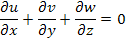

Here u, v, w are the complex amplitudes of the disturbance velocity in the streamwise (x), spanwise (y) and vertical (z) direction, respectively.
Scales: length ~ δv, velocity ~ Umax, time ~  ,
pressure ~
,
pressure ~ 
Reynolds
number: 
Perturbation type:

Solving equations: Orr-Sommerfeld and Squire equations
for  and
and  :
:


where
 ,
,
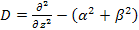 .
.
The problem is considered for t > 0.
Domain boundaries:  .
.
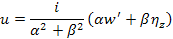
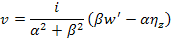
Velocity components:
Vorticity components:



Numerical technique
Discretization: 2th order central finite difference method. The spectrum and the eigenvectors were computed using the QR algorithm.
Computational domain: 2L, where L=20
Grid:
N=1100 nodes; grid strongly stretched near the centerline within the interval  and the uniform grid out of this
interval. The stretching function used is
and the uniform grid out of this
interval. The stretching function used is  , (s=3).
Growth function computation: Euclidean norm of the vector k(t) defined in the eigenvector decomposition:


where  is the Gram matrix and S=FHF
– not unique decomposition. We calculated it using either Cholesky decomposition or SVD.
is the Gram matrix and S=FHF
– not unique decomposition. We calculated it using either Cholesky decomposition or SVD.
The growth function is defined by the first singular value σ1 of the matrix  :
:

Optimal initial vector:

where V(1,·) - first right singular vector.
Validation: the same value of growth function was achived for each of
- SVD+Cholesky
- SVD+SVD
- variational techniques
- ODE solution of initial value linear problem.