
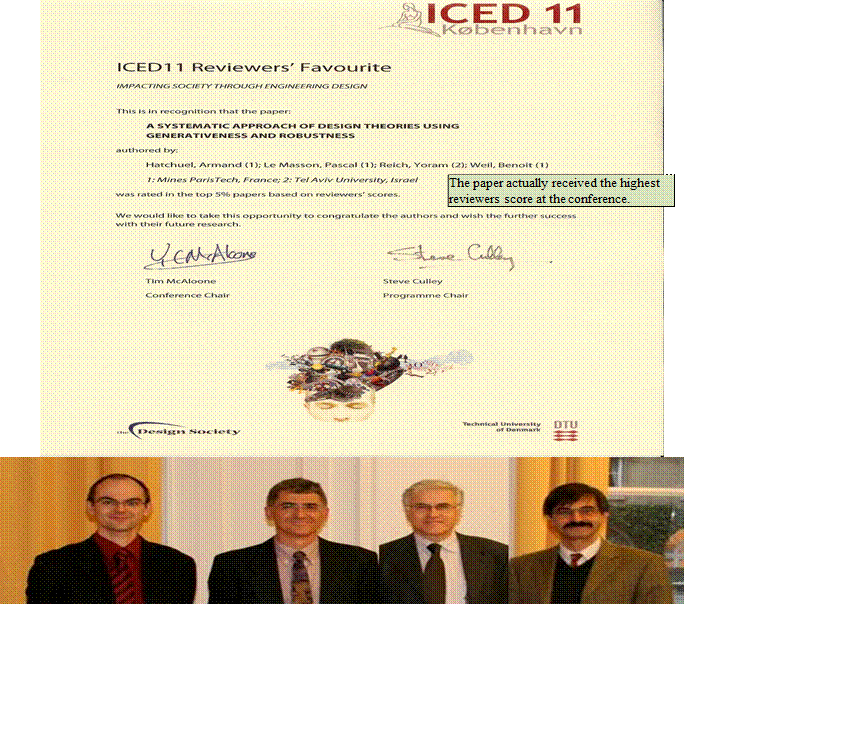
Reviewers Favorite Paper
Award
A systematic approach of design theories
using generativeness and robustness
The
18th International Conference on Engineering Design, ICED'11,
Copenhagen, Denmark, 2011.
[get pdf]
1 MinesParistech, Paris, France.
1 School of Mechanical Engineering, The Iby and Aladar Fleischman Faculty of Engineering, Tel Aviv University, Tel Aviv, Israel.
Abstract
In this paper we build a systematic comparison of
several formal design theories: General Design Theory, Axiomatic Design,
Coupled Design Process, Infused Design and C-K theory. Each theory offers
principles as well as mathematical assumptions and establishes propositions
that we analyze through two main criteria: i) their generativeness,
i.e. their ability to produce design proposals that are different from
existing solutions and design standards; ii) their robustness, i.e. their
ability to produce designs that resist variations of context. Using such
framework, and focusing on the evolution of the mathematical assumptions of
each theory, it can be shown that the development of design theories does not
reflect radically different point of views about design. Instead, there is an
evolution towards more generality and less dependency on predefined objects.
They form altogether a consistent body of knowledge that has aimed to
increase the generativeness of design without
losing its robustness. Thus, Design science can be seen as the science of “generativity”. The evolution of design theories is illustrated
by applying each of them to the same brief: the design of a new camping
chair.
This
work was partially supported by the Design theory and methods for innovation
Chair of Mines ParisTech.
|